Shelterscape Planning & Design Pty Ltd
Home/Urban Notes/Chapter 02

CHAPTER 02 · INTERACTIVE DESIGN STUDY

Voronoi Canopy

Shade that follows the life of the plaza.

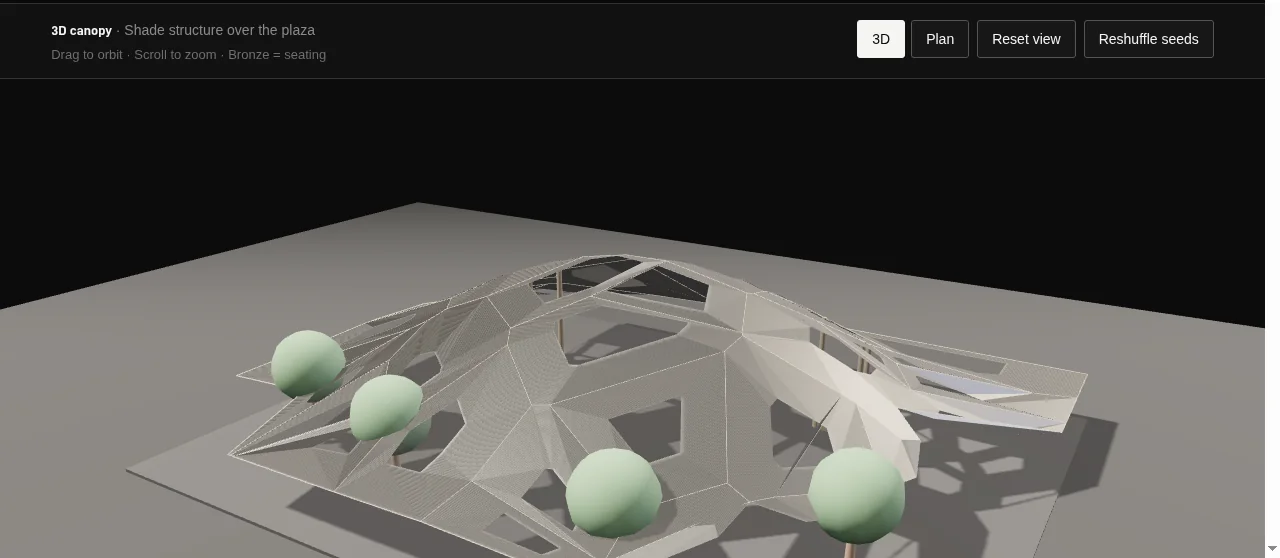
Orbit the canopy, then tune seed count and attractor pull.
Shade densifies where people sit and gather.

3D canopy · Shade structure over the plaza Drag to orbit · Scroll to zoom · Bronze = seating

00 / THE BRIEF

A canopy for a hot public plaza.

The brief is deliberately open: a shade structure over a mid-block plaza in a warm Australian climate (think Melbourne heatwaves or a Perth summer afternoon). The plaza has seating clusters, a cross path, and a few existing trees that stay.

The canopy should throw denser shade where people pause, keep openings where the path wants light and air, and read as one continuous surface rather than a kit of identical umbrellas. Computational design is the right tool: one definition, many calibrated options. The point of the study is not a finished product. It is a transparent method you can rebuild, stress-test and refine.

WHY VORONOI

Cells that feel natural, and build cleanly.

A Voronoi diagram partitions a plane so every region contains the points closest to its seed. The pattern shows up in foam, leaf cells and cracked earth, which is why it reads as intentional rather than forced when you see it overhead. In a canopy it gives three practical advantages:

01 to 08 / PARAMETRIC LOGIC

From plaza to panels, step by step.

The sequence below follows the Grasshopper workflow, step by step.

STEP 01

Site boundary and attractor points

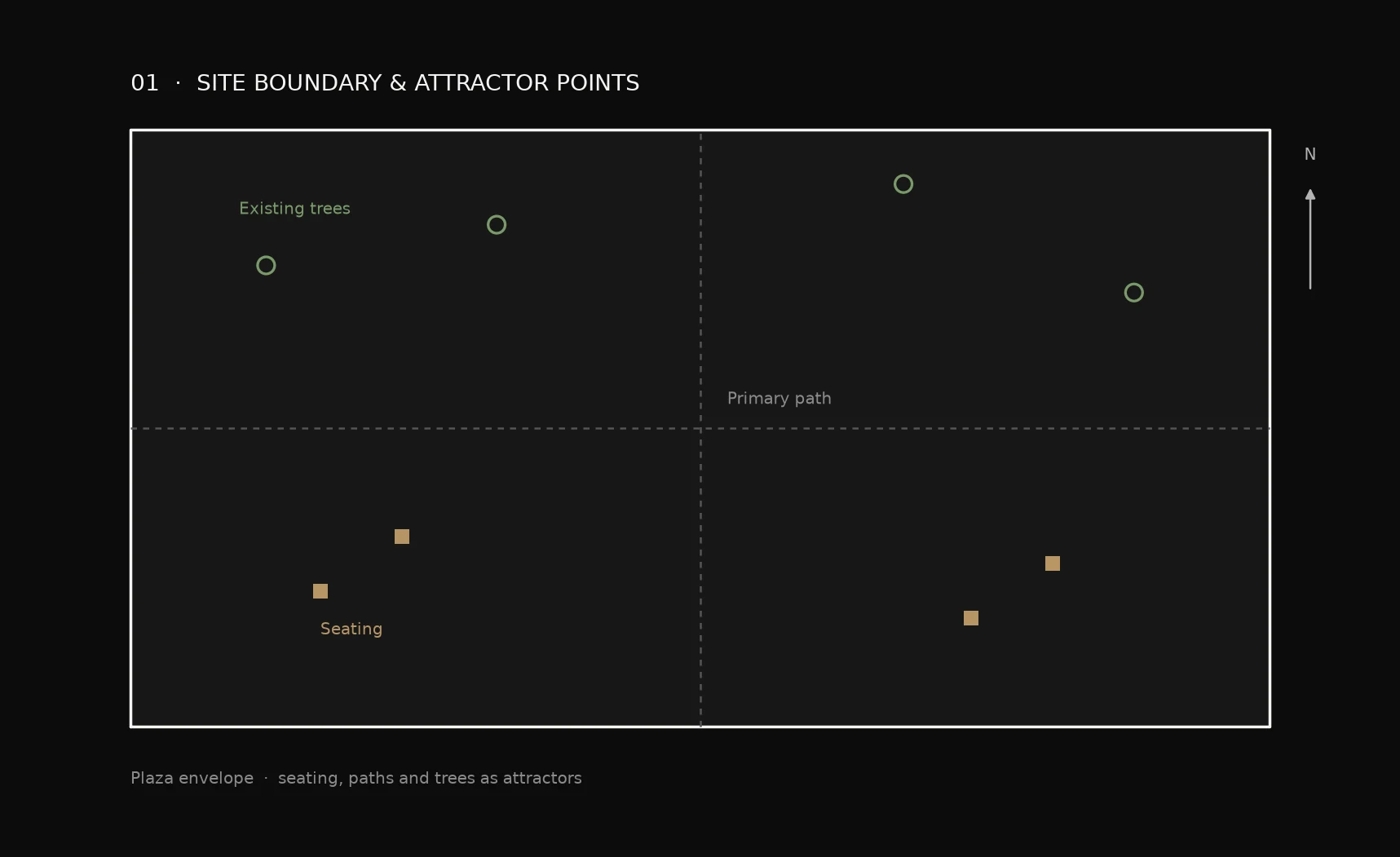
Trace the plaza envelope as a closed curve. Mark seating clusters as strong attractors, path centre-lines as weaker ones, and existing tree trunks as fixed points that the canopy should respect and reinforce with shade.

Curve · Point · Cull Pattern
Plan of a plaza boundary with seating squares, tree rings and dashed primary paths marked as attractors.
Plaza envelope with seating, trees and cross paths as the attractor set.
STEP 02

Seed points weighted by shade need

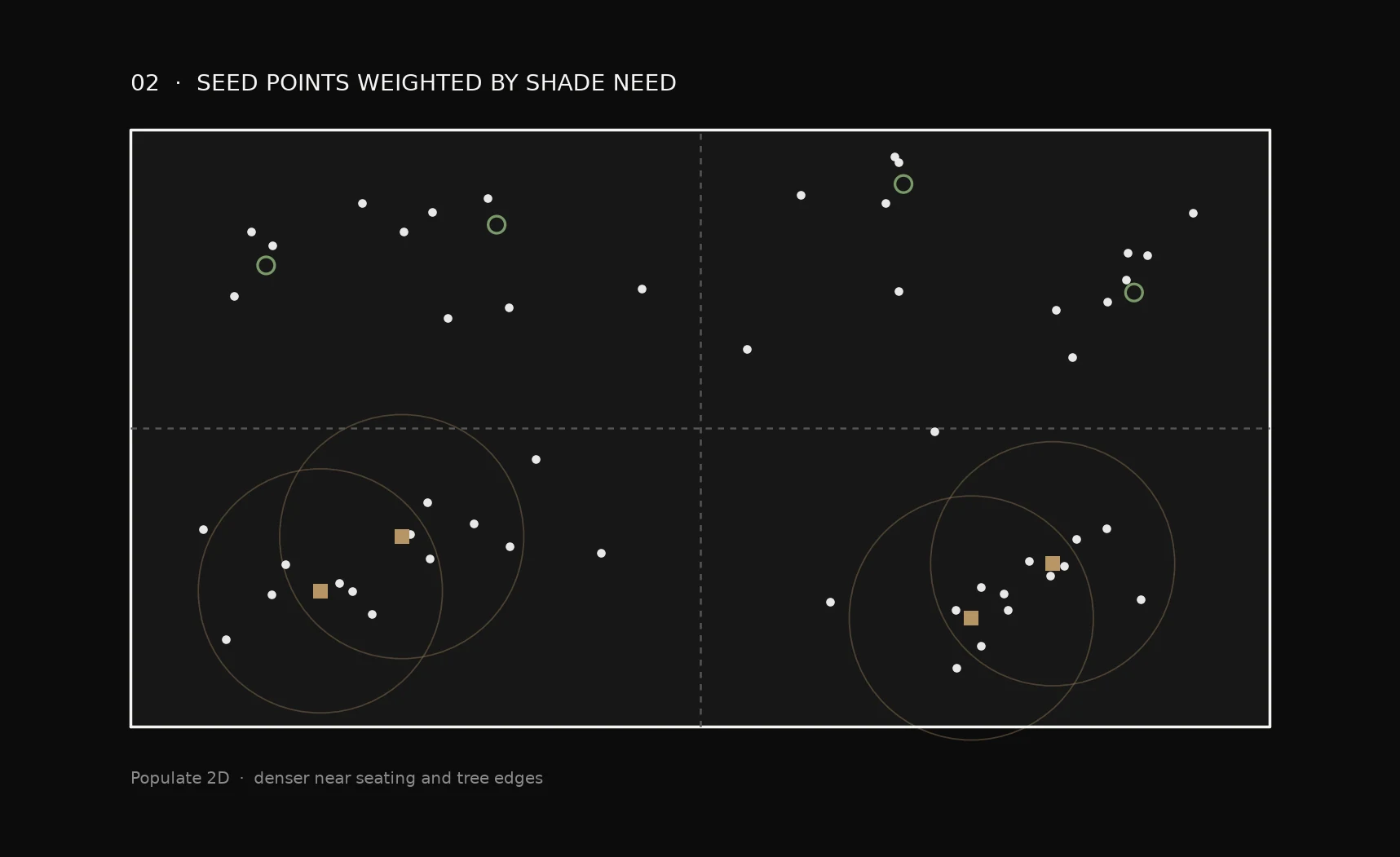
Populate the boundary with seeds. Bias density toward seating and tree edges using a distance field or weighted random sampling. Where people linger in summer, seeds cluster tighter. That is where shade panels will later close up.

Populate 2D · Distance · Remap Numbers
Plaza plan with seed points clustered more densely around seating and tree attractors.
Seed cloud densifies around attractors; the open path stays comparatively sparse.
STEP 03

Generating the Voronoi cells

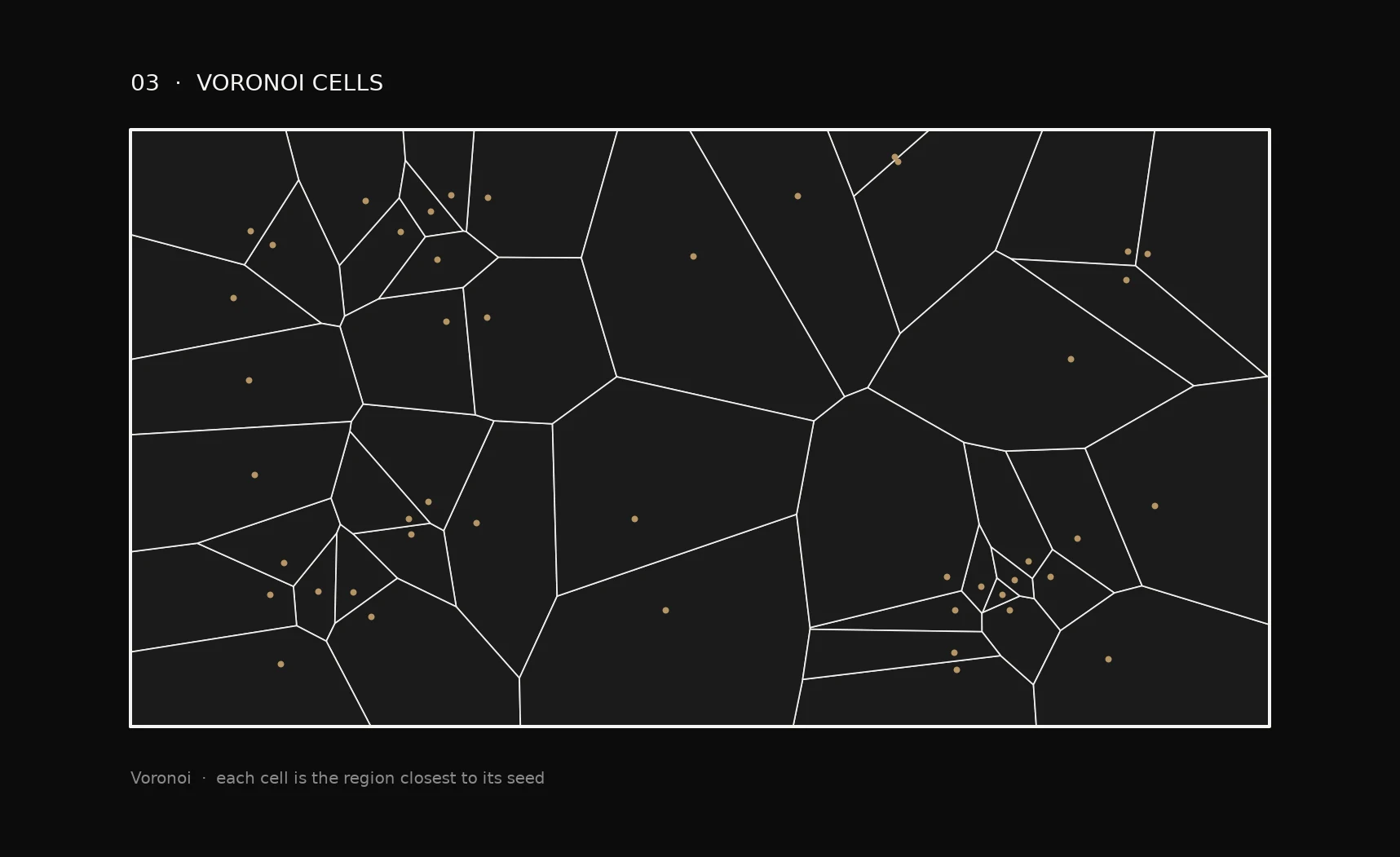
Run Voronoi on the seed set and clip to the plaza curve. Every cell is the region closer to its seed than to any other. At this stage the diagram is still a flat tessellation. Structure and openings come next.

Voronoi · Curve X Curve · Boundary Surfaces
Clipped Voronoi tessellation filling the plaza, with bronze seed points visible inside cells.
Clipped Voronoi tessellation: the working diagram for shade and structure.
STEP 04

Scale and offset into openings

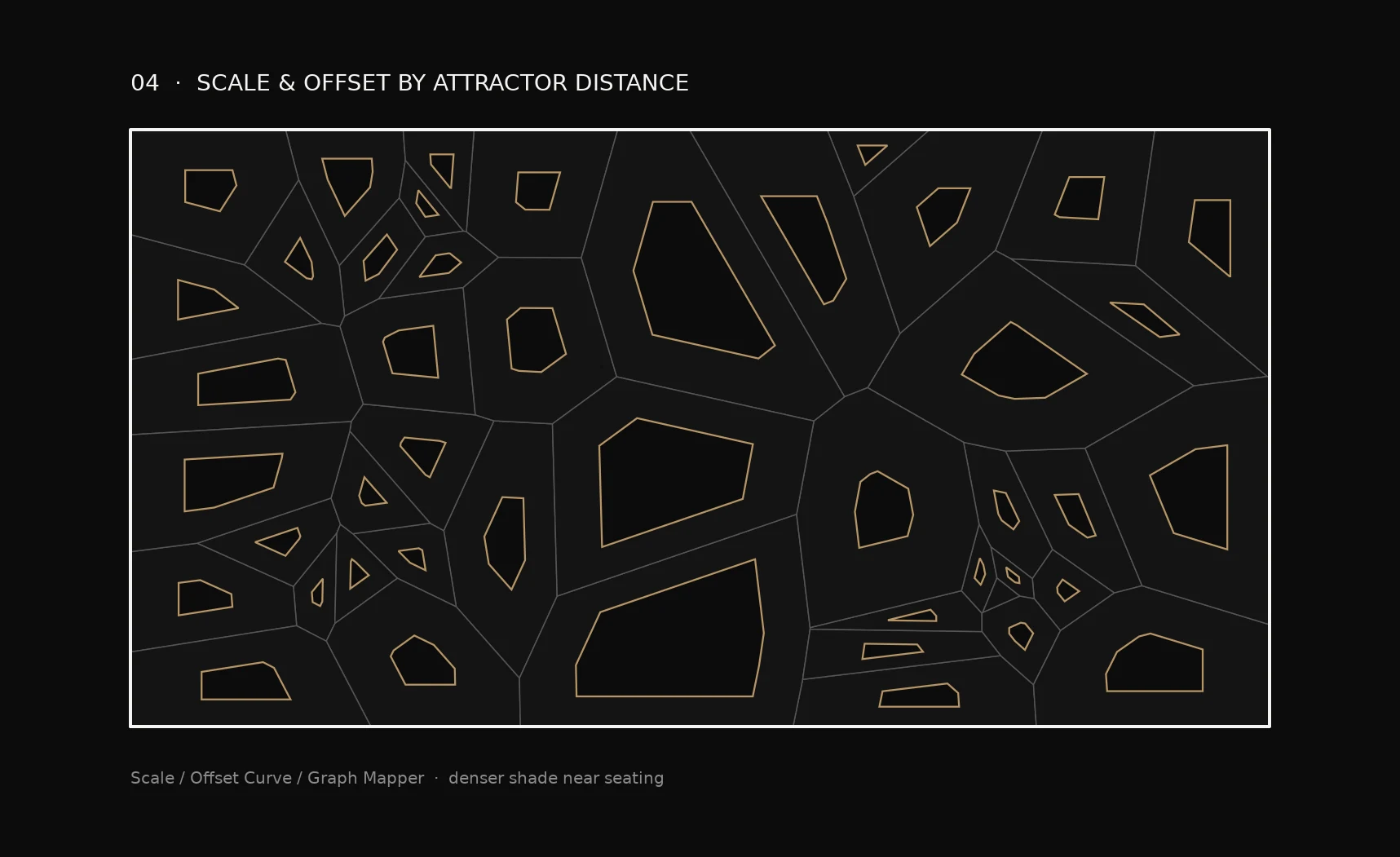
For each cell, measure distance to the nearest attractor. Feed that value through a Graph Mapper and use it to Scale or Offset the cell inward. Near seating the opening shrinks (more solid shade); along the path it grows (more light and air). The interactive plan above is this step, live.

Scale · Offset Curve · Graph Mapper
Voronoi cells with inward-scaled openings; openings are smaller near seating attractors.
Opening size = f(attractor distance). Bronze edges mark the void in each cassette.
STEP 05

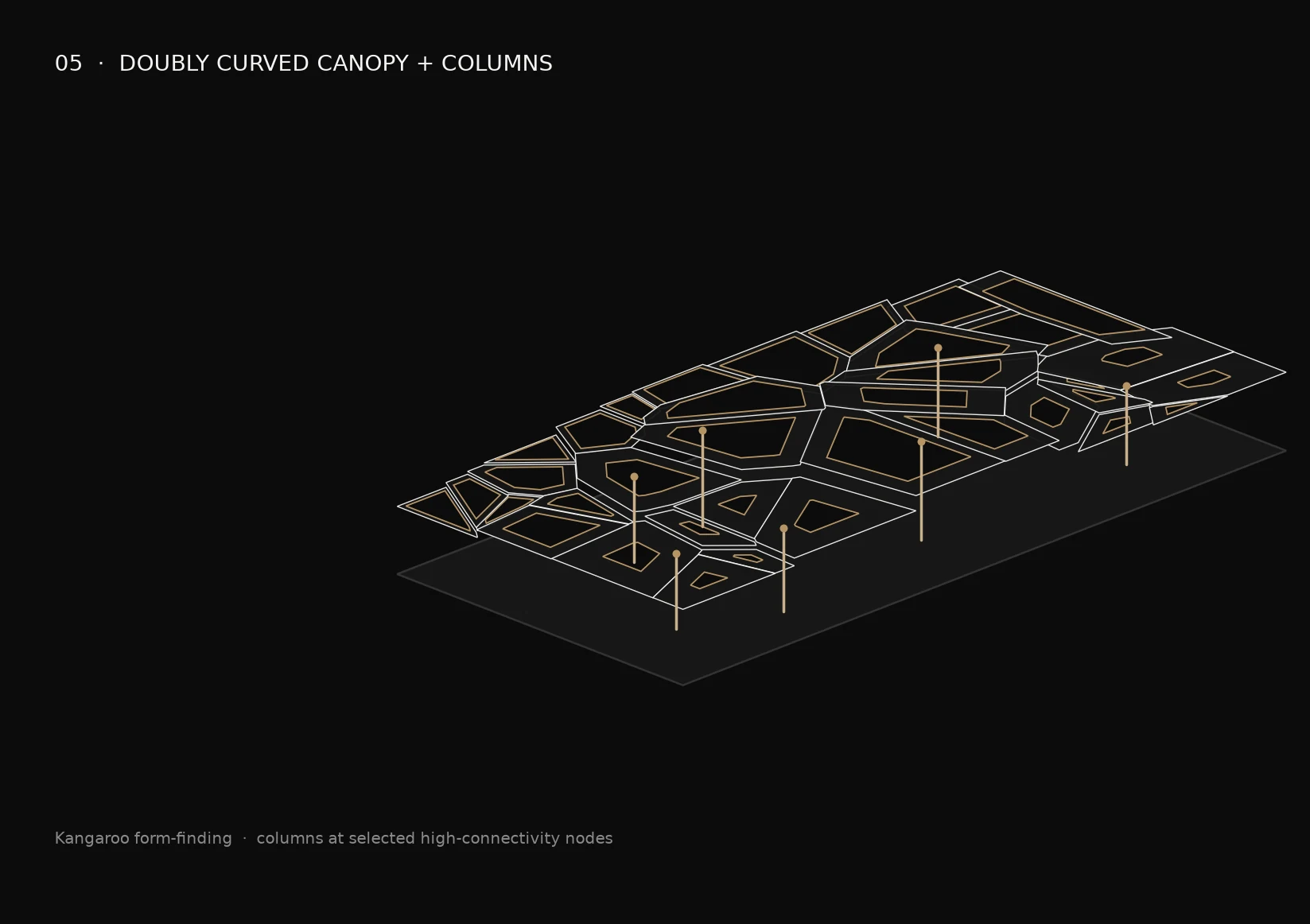
Lift into a doubly curved canopy

Project cell corners onto a target height field (higher toward the centre, easing down at the edges), then relax the mesh with Kangaroo so members share load. Springs or edge-length goals keep panels from warping beyond what flat cassettes can tolerate. Place columns at a shortlist of high-connectivity nodes: corners shared by many cells, near seating but clear of the path. The dual of the Voronoi diagram (the Delaunay triangulation) is a useful guide for bracing.

Kangaroo · Z Coordinate · Cull Index
Axonometric view of a lifted Voronoi canopy with bronze column lines at selected nodes.
Lift study: doubly curved surface with columns at selected dual-graph nodes.
STEP 06

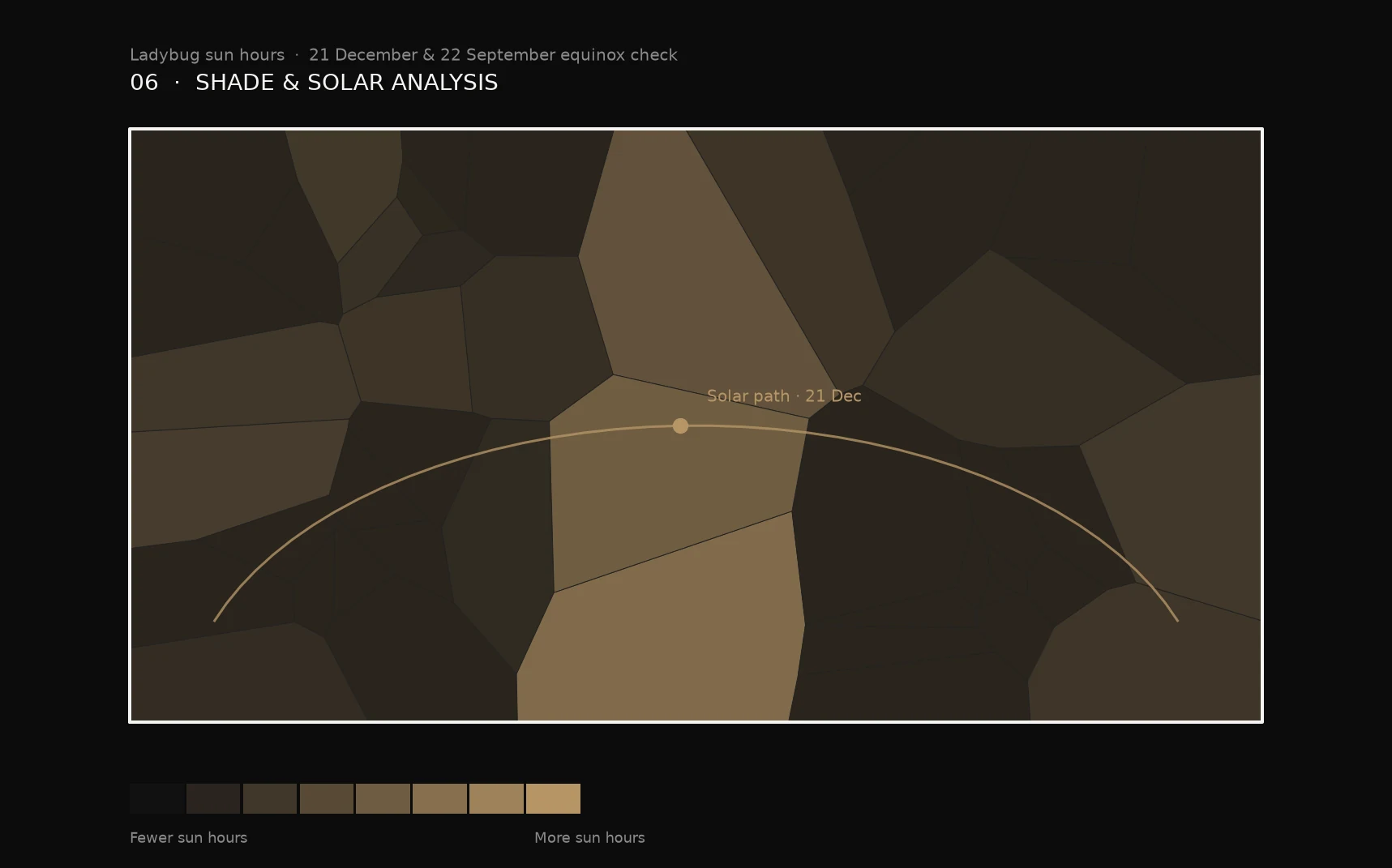
Shade and solar analysis

Run sun-hour studies for 21 December (harsh summer) and 22 September (equinox). Colour the plaza by hours of direct sun with and without the canopy. Check that seating drops into the comfort band while the path keeps enough light. If December shade is good but the equinox feels gloomy, ease the Graph Mapper rather than adding opaque panels everywhere. Ladybug is the usual Grasshopper companion for this.

Ladybug Sunlight Hours · Legend
Voronoi plan coloured by relative sun hours with a solar-path arc for 21 December.
Relative sun-hours field under the canopy. Darker bronze means fewer hours of direct sun.
STEP 07

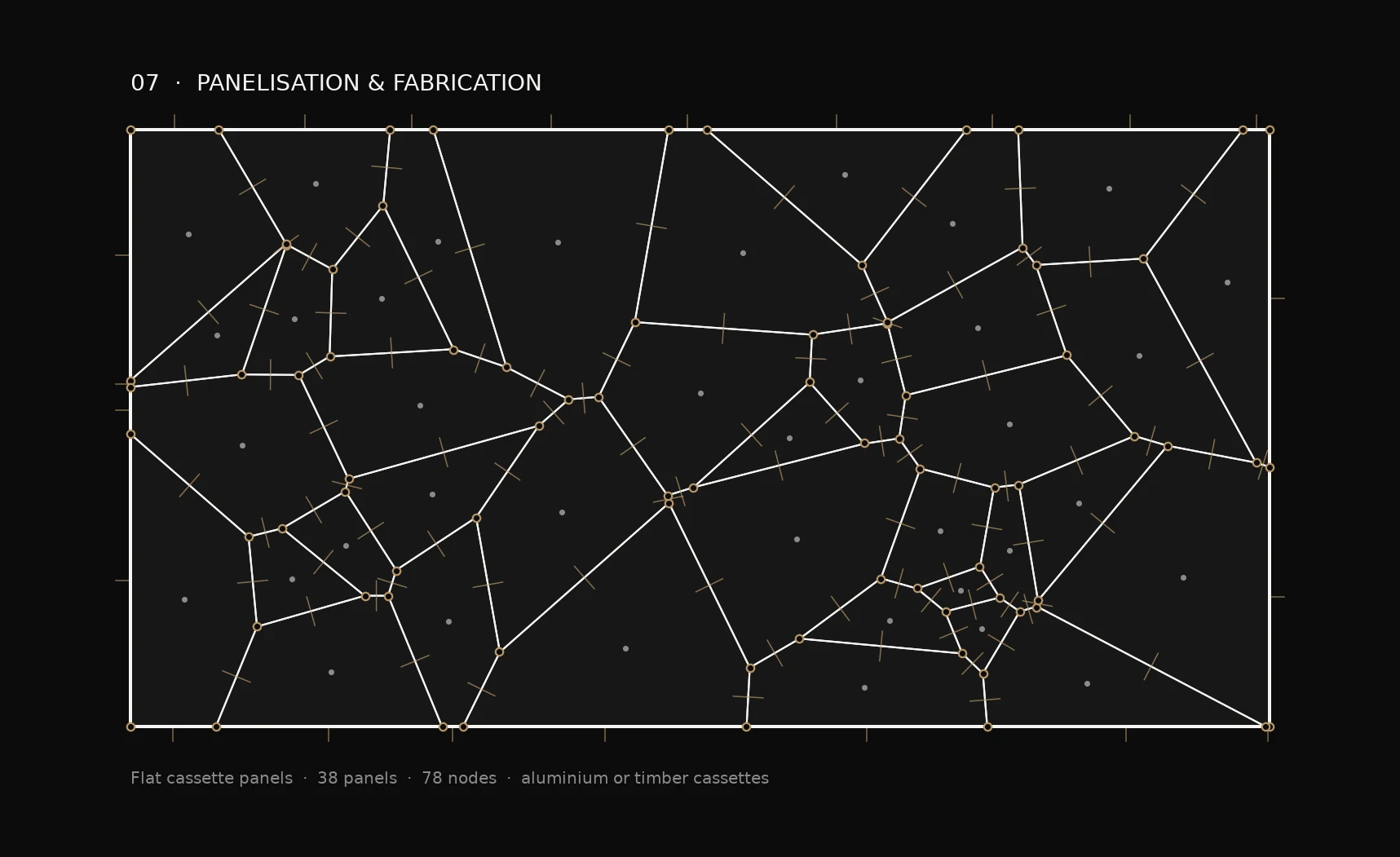
Panelisation and fabrication thinking

Unroll each cell to a flat cassette. Tag nodes and edges for a bill of materials. Typical build-up: aluminium sheet with folded edge returns, or timber ribs with a translucent upper skin. Aim for a node count the fabricator can handle: fewer unique connectors, more repeated details. Drainage paths, gasket lines and access for cleaning belong in the same model, not as an afterthought on a construction issue.

Unroll · Tag · Export
Voronoi panel plan with node rings and short hatch marks suggesting cassette joints.
Flat panel schedule language: nodes, edge ticks and cell centroids as panel IDs.
STEP 08

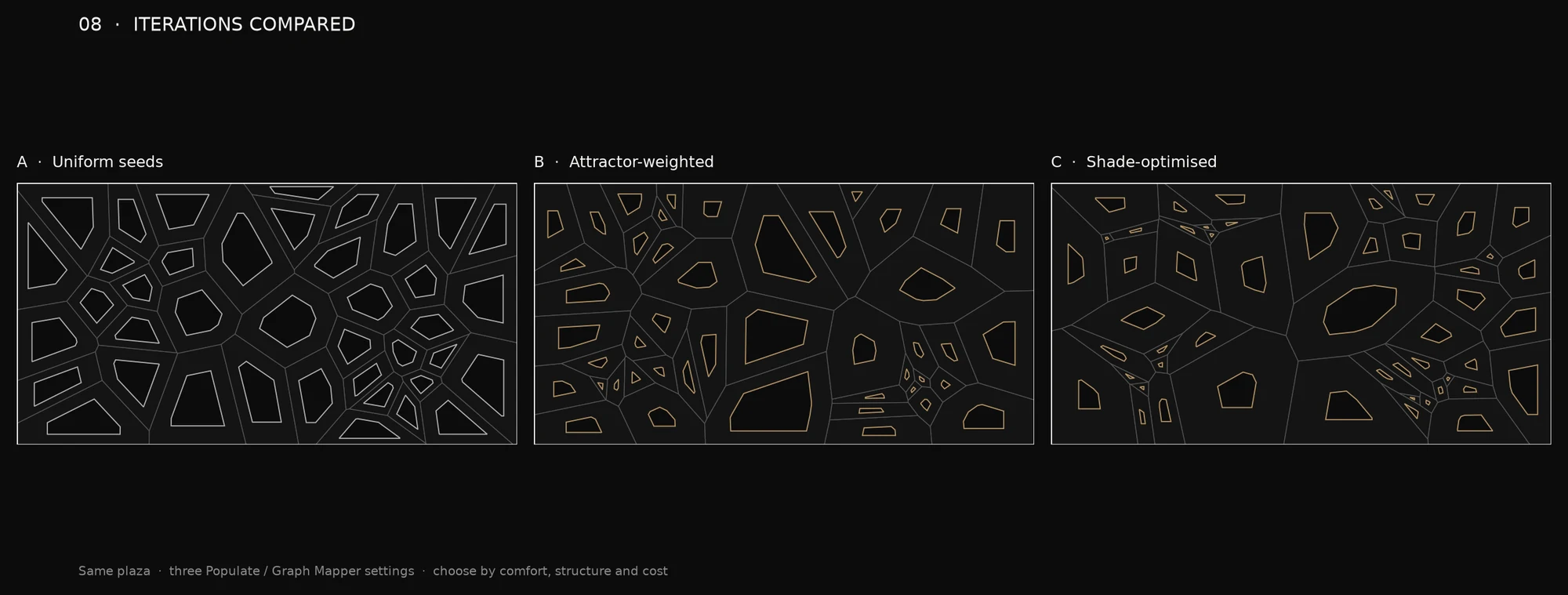
Iterations compared

Keep the plaza fixed and vary only Populate density and Graph Mapper curves. Option A is uniform and honest but bland. Option B weights attractors. Option C pushes shade hard over seating. Choose with comfort plots, column count and fabrication cost on the table, not by which image looks busiest.

Data Dam · Gene Bank · Galapagos (optional)
Three side-by-side Voronoi canopy options: uniform seeds, attractor-weighted, and shade-optimised.
Three options from one definition: same plaza, different Populate and Graph Mapper settings.

GRAPH

One definition. Many canopies.

Boundary and attractors feed Populate 2D. Voronoi builds the cells. Scale and Graph Mapper cut the openings. Kangaroo lifts the form. Ladybug checks the sun. Panelisation closes the loop for fabrication.

Parametric logic graph from boundary and attractors through Voronoi, scale, Kangaroo, Ladybug and panelisation.
Parametric process diagram.

Related reading: Voronoi diagram · Rhino Grasshopper guides · Attractor points tutorial · Kangaroo Physics · Ladybug Tools.